

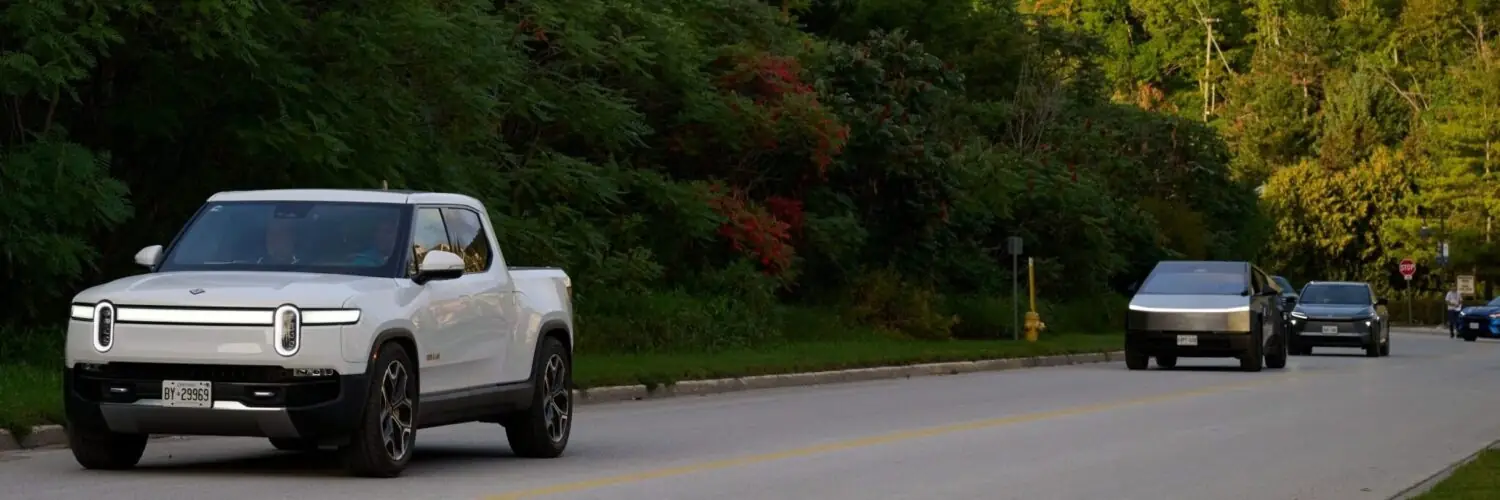
Ottawa, ON, Sept. 21, 2026 – The question for Canadians considering an EV may no longer be how far it can go, but how efficiently it uses energy, how quickly it charges and how much it costs to recharge. Results from the 2026 CAA EV Circuit found significant differences across vehicles in all three areas.
“Range anxiety has long dominated the conversation about electric vehicles, but these results suggest the discussion can shift to more personalized considerations for drivers,” says Ian Jack, vp of public affairs at CAA National. “For many of today’s EVs, the question is becoming less about whether you can complete a trip and more about how efficiently you can make it, where you will charge, how long charging will take, and what it will cost.”
All 22 electric vehicles participating in the CAA EV Circuit completed the same 230-kilometre route without needing to charge, including the vehicle with the shortest advertised range. A 15-minute charging test was completed at the end to capture further data. The route started in Blue Mountain, ON and ended in Vaughan, ON. On average, the vehicles used only 40 per cent of their battery charge over the route.
EVs demonstrate a significant energy-efficiency advantage over traditional gasoline-powered vehicles
The electric vehicles in the Circuit used the energy equivalent of approximately two litres of gasoline per 100 kilometres. By comparison, the average Canadian passenger vehicle consumes roughly eight to 10 litres of gasoline per 100 kilometres.
Energy consumption among the participating EVs ranged from 11.43 kilowatt-hours per 100 kilometres to 28.91 kilowatt-hours per 100 kilometres, illustrating the variation among vehicle sizes, weights and designs. A more efficient EV generally requires less electricity to travel the same distance, which can contribute to lower charging costs and less time spent charging.
A notable finding was that the vehicles in the September 2026 CAA EV Circuit consumed approximately 40 per cent less energy, on average, than the vehicles evaluated during the February 2025 CAA EV Winter Test. While the tests were conducted under different conditions and with different vehicles, the difference highlights the significant impact that temperature can have on EV efficiency.
A short charging stop can meaningfully extend a trip
When it comes to charging experience, during the standardized 15-minute charging session, participating vehicles added an average of 110 kilometres of displayed range. Almost two-thirds of the vehicles added at least 100 kilometres, demonstrating that a brief charging stop can provide a meaningful boost during a longer journey.
A data snapshot of the 2026 CAA EV Circuit are contained in the charts below.
Results differed significantly among vehicles. The displayed driving range added during the 15-minute session varied from 58 kilometres to 178 kilometres. Charging performance can be affected by the vehicle, charger, battery temperature, battery state of charge and conditions at the time of charging.
These results also highlight the effect of Canadian climate variations. Vehicles tested in the September 2026 CAA EV Circuit added approximately 15 per cent more displayed range during the charging session than the group evaluated during CAA’s 2025 EV Winter Test.
“For Canadians planning longer drives, knowing a vehicle’s total range is only part of the equation,” continues Jack. “Drivers should also understand how their vehicle charges and recognize that the number of kilometres added during a stop can change depending on the vehicle and the charging conditions.”
“Just as Canadians compare fuel economy when buying a gasoline-powered vehicle, they should compare energy efficiency and charging performance when considering an EV,” says Jack. “Where and how often someone expects to charge can make a substantial difference to their experience and road-trip costs.”
Additional information is available here – 2026 CAA EV Circuit: Complete Vehicle Findings
-30-
About the CAA EV Circuit
The CAA EV Circuit was conducted on September 16, 2026, with 22 electric vehicles travelling the same 230-kilometre route from Blue Mountain to Vaughan, Ontario, across city streets, rural roads and highways. Using a neutral data-driven methodology, all vehicles followed the same route, operated under consistent settings and participated in a standardized charging session. Performance data was collected throughout the drive and validated by CAA’s business intelligence and automotive experts.
About CAA
CAA is a federation of eight Clubs providing nearly 8 million Members with exceptional emergency roadside service, complete automotive and travel services, Member savings and comprehensive insurance services. As one of Canada’s most trusted brands, CAA also advocates on issues of concern to its Members and all Canadians, including road safety, the environment, mobility, infrastructure, and consumer protection.
Media Contact:
Murielle Pierre
Manager, Public Affairs
mpierre@national.caa.ca
613-698-1201
2026 CAA EV Circuit Data Snapshot
Most kilometres gained in a 15-minute charging session
|
Make |
Model |
. Kilometres gained |
|
Lucid |
Gravity |
178 km |
|
Hyundai |
IONIQ 5 |
136 km |
|
Mercedes-Benz |
CLA with EQ Technology |
135 km |
|
Cadillac |
LYRIC |
131 km |
|
Nissan |
LEAF |
126 km |
Least kilometres gained in a 15-minute charging session
|
Make |
Model |
Kilometres gained |
|
Lucid |
Air |
58 km |
|
Chevrolet |
Equinox EV |
71 km |
|
Chevrolet |
Silverado EV |
80 km |
|
GMC |
HUMMER EV SUV |
90 km |
|
Tesla |
Model Y |
97 km |
Lowest energy consumption (kWh/100 km)
|
Make |
Model |
Energy used |
|
Toyota |
bZ |
11.43 kWh |
|
Tesla |
Model Y |
11.81 kWh |
|
Tesla |
Model 3 |
11.85 kWh |
|
Kia |
EV4 |
11.89 kWh |
|
Nissan |
LEAF |
12.48 kWh |
Highest energy consumption (kWh/100 km)
|
Make |
Model |
Energy used |
|
Lucid |
Gravity |
28.91 kWh |
|
GMC |
HUMMER EV SUV |
23.55 kWh |
|
Tesla |
Cybertruck |
23.41 kWh |
|
Rivian |
R1T |
19.96 kWh |
|
Cadillac |
LYRIQ |
19.1 kWh |